


 English
 中文简体
中文简体
Industry News
How to Calibrate a Truck Scale: Step-by-Step Guide
Content
- 1 The Direct Answer: What Truck Scale Calibration Actually Involves
- 2 Equipment You Need Before Starting Truck Scale Calibration
- 3 Step-by-Step Process to Calibrate a WW Scale or Any Truck Scale
- 4 Tolerance Standards Every Truck Scale Operator Must Know
- 5 Common Calibration Problems on Truck Scales and How to Fix Them
- 6 How Often Should a Truck Scale Be Calibrated
- 7 Preventive Maintenance That Keeps Truck Scale Calibration Stable
- 8 DIY Calibration vs. Hiring a Certified Scale Technician
- 9 Legal and Financial Consequences of Running an Uncalibrated Truck Scale
The Direct Answer: What Truck Scale Calibration Actually Involves
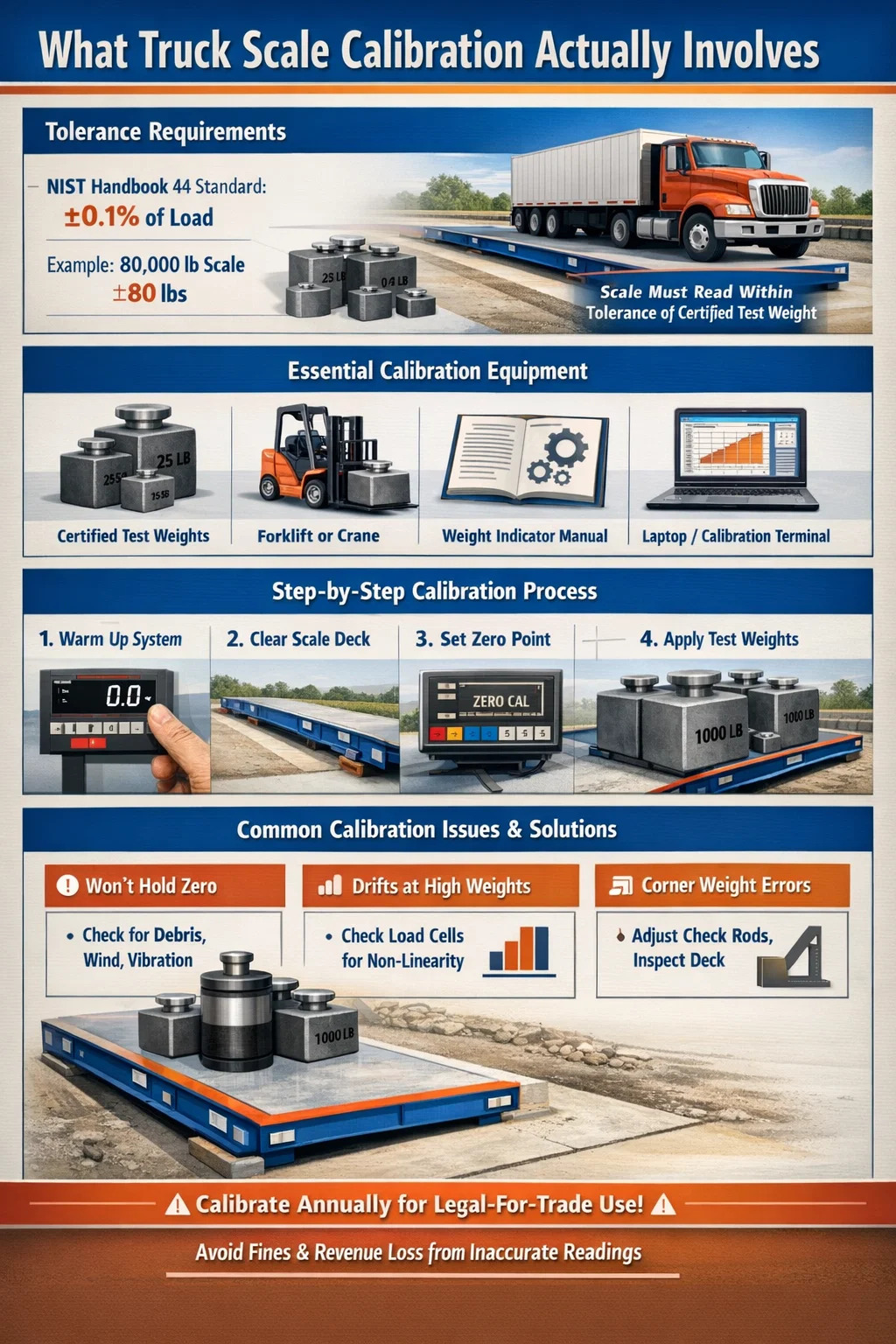
Calibrating a truck scale means adjusting the scale's internal settings so that the weight readings it produces match known reference weights within an acceptable tolerance. For most commercial truck scales, that tolerance is ±0.1% of the applied load, as defined by the National Institute of Standards and Technology (NIST) Handbook 44. In practice, this means a 80,000 lb truck scale must read within ±80 lbs of a certified test weight at any given load point.
The process involves placing certified test weights or a loaded vehicle of known weight on the scale deck, reading the indicator output, and adjusting the calibration parameters in the weight indicator or junction box until the displayed reading falls within tolerance. Most modern digital truck scales use software-based span and zero adjustments, while older analog systems may require physical potentiometer changes.
Calibration is not optional for legal-for-trade applications. If your truck scale is used for commercial transactions — billing by weight, government compliance, or USDA-regulated commodity sales — it must be calibrated and certified by a licensed weights and measures inspector at intervals determined by your state or jurisdiction, typically every six to twelve months.
Equipment You Need Before Starting Truck Scale Calibration
Attempting calibration without the right equipment produces unreliable results. Here is what a proper truck scale calibration setup requires:
- Certified test weights: Class F cast iron weights certified by a state weights and measures authority. For a full-capacity truck scale calibration, you ideally want test weights equal to at least 50% of the scale's rated capacity. A 100,000 lb capacity scale needs a minimum of 50,000 lbs in certified test weights for a meaningful multi-point calibration.
- Weight indicator or controller manual: Every indicator model has a specific calibration entry sequence. Common brands include Mettler Toledo, Rice Lake, Fairbanks, and Cardinal. Without the manual, you cannot access calibration mode correctly.
- Forklift or crane: Certified test weights for a truck scale weigh hundreds to thousands of pounds each. You need lifting equipment rated for the job.
- Calibration record sheet: Document every test weight placement, indicator reading, and adjustment made. This is mandatory for legal-for-trade certification and useful for diagnosing drift over time.
- Laptop or configuration terminal (for digital systems): Many modern truck scales connect via RS-232 or USB to a configuration interface. Software tools like Mettler Toledo's CalFree or Rice Lake's Revolution software streamline the process.
- Level and temperature gauge: The scale deck must be level and the ambient temperature should be noted. Load cells have rated temperature compensation ranges, typically -10°C to +40°C. Calibrating outside this range produces inaccurate results.
If certified test weights are not available, some facilities use a substitution method with a vehicle of precisely known weight — confirmed by a third-party certified scale immediately before use. This approach is acceptable for internal verification but is generally not accepted for legal-for-trade certification by inspectors.
Step-by-Step Process to Calibrate a WW Scale or Any Truck Scale
The following procedure applies to the majority of digital pit-mounted and surface-mounted truck scales. Steps may vary slightly based on indicator brand and load cell configuration.
Step 1: Warm Up the System
Power on the weight indicator and allow it to warm up for a minimum of 15 to 30 minutes. Electronic components in the indicator and load cells require thermal stabilization to produce stable readings. Calibrating a cold or recently powered system introduces drift errors that may not appear until the equipment reaches operating temperature.
Step 2: Clear the Scale Deck Completely
Remove all material, vehicles, debris, and standing water from the scale platform. Even a small amount of material — 50 lbs of gravel or a puddle of water — will corrupt your zero reference. Inspect the scale pit for sediment buildup, especially in below-grade installations. Sediment pressing against the underside of the deck creates mechanical resistance that reduces accuracy across the entire weighing range.
Step 3: Set the Zero Point
Access the calibration menu on your weight indicator. The exact key sequence varies by model — for example, on a Rice Lake 920i, you hold the ZERO key for three seconds while in setup mode; on a Mettler Toledo IND560, you navigate through the maintenance menu. Once in calibration mode, apply the zero calibration with nothing on the scale. The indicator records the unloaded millivolt output from the load cells as the zero reference point. Do not press the zero button from the normal operating screen — this only applies a software offset, not a true calibration zero.
Step 4: Apply the Span Weight
Place your certified test weights on the scale deck. For the most accurate span calibration, the test weight should be at least 25% of the scale's capacity, with 50% or higher preferred. Distribute the weights as evenly as possible across the deck surface. Enter the exact known weight value into the indicator's calibration menu and confirm the span calibration. The indicator now maps the millivolt output at that load to the entered weight value, establishing the linear calibration slope.
Step 5: Perform Multi-Point Linearity Checks
After setting zero and span, verify accuracy at multiple load points. Remove the test weights, confirm the display returns to zero, then add weights incrementally and record readings at 25%, 50%, 75%, and 100% of capacity. Each reading should fall within the NTEP or OIML tolerance for that load. If a mid-range reading falls outside tolerance, the load cells may have linearity issues, or the junction box trim potentiometers need adjustment to balance individual cell outputs.
Step 6: Conduct Corner Loading Tests
Place a known weight on each quadrant of the scale deck individually and record the reading from each position. On a properly calibrated and balanced truck scale, the same weight should read within ±0.1% of the applied load regardless of where on the deck it is placed. Significant corner-to-corner variation indicates a mechanical problem — a bent deck, a load cell with reduced output, or a check rod binding — rather than a calibration issue. Adjusting calibration to compensate for a mechanical defect will not fix the underlying problem and may worsen accuracy at other load positions.
Step 7: Document and Lock the Calibration
Record all test weights used, placement positions, indicator readings before and after adjustment, ambient temperature, date, and the name of the person performing the calibration. Most legal-for-trade indicators have a calibration seal or security parameter that must be engaged after calibration to prevent unauthorized changes — engage it. Attach the calibration certificate from the test weight supplier to your records. This paperwork is required for any state inspection and is your legal documentation in the event of a commercial dispute.
Tolerance Standards Every Truck Scale Operator Must Know
Understanding tolerance standards helps you interpret calibration results correctly and know when a scale truly needs adjustment versus when it is performing within spec.
| Standard | Application | Acceptance Tolerance | Maintenance Tolerance |
|---|---|---|---|
| NIST HB 44 (USA) | Commercial, legal-for-trade | ±0.1% of load | ±0.2% of load |
| OIML R 76 | International trade | ±0.5 e (verification scale division) | ±1.0 e |
| NTEP (USA) | Type approval for commercial devices | ±1 division (d) at zero; ±0.5 d above | Varies by class |
| Internal / Industrial | Non-commercial process weighing | Defined by facility SOP | Defined by facility SOP |
The maintenance tolerance is the threshold at which an in-service scale must be taken out of legal-for-trade use and recalibrated. It is typically twice the acceptance tolerance. A scale that reads within maintenance tolerance but outside acceptance tolerance can continue operating commercially until its next scheduled inspection, at which point it must be recalibrated to pass.
Common Calibration Problems on Truck Scales and How to Fix Them
Scale Won't Hold Zero
If the scale display drifts from zero after calibration — say, showing +20 lbs or -15 lbs within minutes of setting zero with nothing on the deck — the cause is almost always environmental rather than a calibration error. Check for wind loading on the deck in exposed outdoor installations, vibration from nearby machinery, thermal expansion of the scale frame, or debris contacting the underside of the deck. Fix the physical condition first, then recalibrate.
Reading Is Accurate at Low Weights but Drifts at High Weights
This pattern — where a 20,000 lb test reads correctly but a 60,000 lb test reads 200 lbs high — points to a non-linearity issue. The most likely cause is a load cell with degraded output curve characteristics, often the result of overloading or corrosion damage. A load cell diagnostic using a millivolt meter will show which cell is producing a non-linear output as load increases. Replacing that cell and recalibrating will resolve the issue. Simply adjusting span calibration will not fix a non-linear cell — it will correct one load point while making others worse.
Corner Weight Discrepancies Larger Than 0.2%
Corner-to-corner variation beyond tolerance almost always has a mechanical cause. Common culprits include check rods — the horizontal restraint links on truck scales — that are adjusted too tight, preventing the deck from moving freely onto the load cells. Loosen check rod tension until there is a small amount of free play (typically 1/16 to 1/8 inch) and retest. Also check for deck contact with the pit walls, which acts as a mechanical bypass around the load cells and reduces apparent weight for loads positioned near the contact point.
Indicator Shows Error Code Instead of Weight
Error codes during calibration typically indicate the indicator cannot detect a valid millivolt signal from the load cells. Check all cable connections at the junction box and indicator. Measure the excitation voltage — most systems run 10V DC excitation — and confirm it matches spec. A damaged load cell cable can pass visual inspection but still have a broken wire internally; a continuity test with a multimeter is more reliable than a visual check.
Calibration Passes Immediately but Fails Within Days
Rapid calibration drift after a successful calibration session suggests moisture ingress into a load cell or junction box. Water changes the electrical resistance of internal components, shifting the millivolt output without any change in physical load. Inspect all conduit entry points and junction box seals. Compressed air blown through conduit can sometimes temporarily clear moisture, but a load cell with internal water damage will need replacement — drying it out does not restore original accuracy.
How Often Should a Truck Scale Be Calibrated
Calibration frequency depends on how the scale is used, what it weighs, and what regulatory requirements apply. Here are the practical benchmarks:
- Legal-for-trade commercial use: Most US states require annual inspection and recertification by a licensed weights and measures official. Some high-volume operations in certain states require semi-annual inspections.
- High-throughput facilities (100+ trucks per day): Consider quarterly internal verification using a test vehicle of known weight, with a full certified calibration annually or after any significant maintenance event.
- After any overload event: If a vehicle significantly exceeds the scale's rated capacity — for a 100,000 lb scale, that means a load above roughly 120,000 lbs — calibration verification is mandatory. Overloads can permanently deform load cells.
- After structural repairs or indicator replacement: Any time a component directly in the weighing signal path is changed, recalibration is required before the scale returns to service.
- After extreme weather events: Flooding, freezing temperatures below the load cell's rated range, or high winds that may have caused debris impact on the deck warrant a verification check before resuming commercial use.
Between formal calibrations, daily zero checks are a simple and effective monitoring practice. With nothing on the deck, the indicator should read zero within ±1 display division. If it consistently reads outside this range, investigate before the next scheduled calibration rather than waiting.
Preventive Maintenance That Keeps Truck Scale Calibration Stable
Calibration accuracy is not just about the calibration event itself — it is the result of consistent maintenance between calibration sessions. A well-maintained truck scale holds calibration far longer and requires fewer adjustments at each inspection.
Pit Cleaning for Below-Grade Installations
The scale pit should be cleaned at minimum twice per year, more frequently in environments with heavy mud, grain dust, coal dust, or other fine materials. Accumulated material in the pit creates upward pressure on the deck that artificially inflates readings. A scale that reads 200 lbs over actual weight after sitting through a wet winter is typically a dirty pit problem, not a calibration problem. Pumping standing water and removing sediment restores accuracy without touching the calibration settings.
Load Cell and Cable Inspection
Inspect load cell cables and conduit runs annually for rodent damage, corrosion at connectors, and physical damage from vehicles driving off the approach ramp onto the conduit. A single degraded cable connection can add measurement noise of 50 to 150 lbs to all readings. Load cell mounting hardware — bolts, mounting feet, and bumper blocks — should be inspected for corrosion and torqued to specification during the same inspection.
Approach and Exit Ramp Condition
Damaged or uneven approach ramps cause vehicles to enter the scale deck at an angle or with one axle already partially on the approach. This can produce inconsistent readings for the same vehicle depending on approach speed and angle. Approach ramps should be level with the scale deck and maintained at regular intervals. A height differential of more than 1/2 inch between the ramp surface and the scale deck warrants repair.
Junction Box Moisture Control
Many calibration failures trace back to moisture in the junction box rather than a true calibration shift. Replace desiccant packs in the junction box annually. Inspect the conduit seal at the junction box entry point — the most common moisture entry path — and reseal with appropriate conduit sealing compound if any gaps are visible. If the junction box is installed in a location subject to standing water or flooding, consider relocating it to a higher position.
DIY Calibration vs. Hiring a Certified Scale Technician
Whether to calibrate a truck scale in-house or hire a certified technician depends on the application and what you are trying to achieve.
- Internal verification (non-legal-for-trade): If you own certified test weights, have access to the indicator calibration manual, and the scale is used strictly for internal process control, in-house calibration is both feasible and cost-effective. A capable maintenance technician can perform this with appropriate training.
- Legal-for-trade certification: This must be performed or witnessed by a state-licensed weights and measures official. No amount of in-house calibration work qualifies a scale for commercial use without that official stamp. In most states, the inspector brings their own certified test weights.
- Diagnostic calibration after a problem: When calibration fails unexpectedly or the scale exhibits abnormal behavior, a certified scale service company with proper diagnostic equipment — millivolt meters, load cell simulators, and certification-grade test weights — will identify the root cause faster and more reliably than in-house troubleshooting.
The cost of a professional truck scale calibration service typically ranges from $300 to $800 for a standard visit, depending on location, scale size, and the number of test weight placements required. For a scale handling millions of dollars in commercial transactions annually, this is a negligible operating cost relative to the financial exposure of using an inaccurate scale.
Legal and Financial Consequences of Running an Uncalibrated Truck Scale
Running a commercial truck scale without current calibration certification is not just a technical compliance issue — it carries direct financial and legal consequences that vary by jurisdiction but are consistently significant.
- Civil fines: State weights and measures agencies can issue stop-use orders and fines for operating an uncertified commercial scale. Fines typically range from $500 to $10,000 per violation depending on the state and whether the violation is repeat or first-time.
- Commercial disputes: If a customer challenges a weight-based invoice and your scale lacks current calibration documentation, your legal position is extremely weak. Courts and arbitrators routinely rule against the party that cannot produce calibration records.
- Revenue loss from inaccurate readings: A scale reading consistently 100 lbs low on a truck scale processing 200 loads per day means you are giving away approximately 20,000 lbs of material daily. At $50 per ton, that is $500 per day or over $180,000 per year in unrecovered revenue.
- Regulatory agency audits: In regulated industries like grain trading, coal handling, or scrap metal recycling, an uncalibrated scale can trigger a full audit by federal or state agencies, which carries far greater costs in time and potential penalties than maintaining a proper calibration schedule.
Calibration is not overhead — it is protection. The cost of maintaining a properly calibrated and documented truck scale is a fraction of the cost of a single commercial dispute, fine, or revenue loss event resulting from scale inaccuracy.
Copyright © Ningbo Jiuding Weighing Equipment Co., Ltd.
